Can I Build an ADU on My Bonney Lake Property?
The short answer
Often, yes. Washington’s HB 1337 requires cities in urban growth areas, including Bonney Lake, to allow at least two accessory dwelling units on lots zoned for single-family homes and bars rules that make the owner live on site, and Bonney Lake rewrote its ADU code to match in June 2025. What decides it for a given lot is city or county jurisdiction, sewer or septic, and your HOA covenants, so confirm current rules with City of Bonney Lake planning or Pierce County Planning and Public Works before you design anything.

6 min read
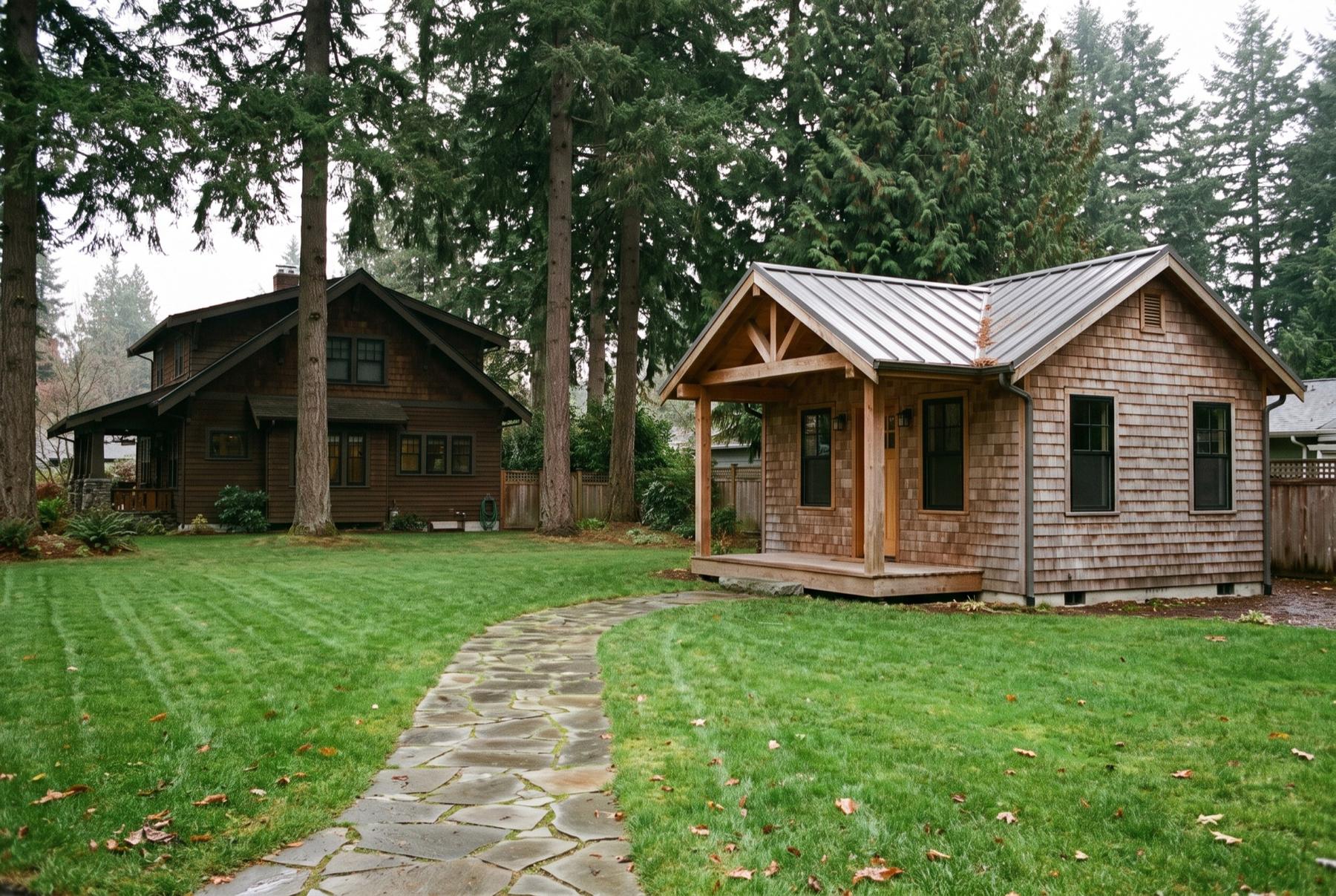
Most people picture a detached cottage across the back lawn, which is also the most involved kind of ADU to permit and build. Before anyone draws a floor plan, work out which rules govern your lot. On the plateau, that depends on more than the city name in your mailing address.
What changed with Washington’s HB 1337
In 2023 the Legislature passed HB 1337, a statewide law meant to make accessory dwelling units easier to build. It applies to cities and counties planning under the Growth Management Act, for lots inside urban growth areas, which covers the city of Bonney Lake. In broad strokes, the law:
- requires those jurisdictions to allow at least two ADUs on lots in zones that allow single-family homes, attached, detached or one of each;
- bars rules that make the owner live on the property;
- limits how much off-street parking and how many design restrictions a city can pile onto an ADU;
- allows ADUs inside existing structures, such as a detached garage.
Cities had deadlines to bring their codes into line. Where a city hadn’t finished by its deadline, the state’s rules applied directly until local code caught up. Bonney Lake adopted its update in June 2025 (Ordinance 1737), which rewrote the city’s ADU rules, and parts of its sewer and water code, to follow HB 1337.
Size limits, setbacks, height and parking are set in local code, and that is the code that changed. A builder’s website or an older blog post may describe rules that no longer apply. Read the current code, then confirm it with a planner before you spend money on drawings. Building codes, utility requirements and private covenants still apply, and those are where many projects stall.
City of Bonney Lake or Pierce County: who reviews your plans
Plenty of houses with a Bonney Lake mailing address sit outside city limits. Much of the Lake Tapps area is unincorporated Pierce County, and so is all of Tehaleh. If your parcel is inside the city, your plans go to the City of Bonney Lake. If it’s unincorporated, they go to Pierce County Planning and Public Works. The Pierce County Assessor-Treasurer’s parcel record shows which one you’re dealing with.
A second line matters as well. HB 1337 reaches lots inside urban growth areas. Rural parcels outside that boundary, including some of the acreage out toward Buckley, follow the county’s own ADU rules, which can be quite different.
Whichever office it is, call or visit before you hire anyone. Bring the parcel number, a rough sketch of where the unit would sit and a clear idea of whether it would be attached or detached. A planner can tell you which code sections apply and which departments will review the project. That conversation costs you an afternoon and can save a set of plans.
Sewer, septic, and water: the limit many lots hit first
Zoning may allow a second unit on paper. The pipes decide whether it’s realistic.
On sewer. Most newer subdivisions in the city are on public sewer. An ADU on a sewered lot still needs a connection plan, sometimes a separate side sewer, and it may carry connection charges. Ask the city’s utility staff early. Where the sewer main sits relative to the back of the lot can shape where a detached cottage makes sense.
On septic. Older parts of Bonney Lake and many properties around the plateau still run on septic. A septic system is designed for a certain household load, usually tied to bedroom count, and an ADU adds to it. The Tacoma-Pierce County Health Department reviews septic questions, and the answer can range from the existing system working as is to the lot lacking room for a second unit and the larger system it would need.
Inside city limits, the code’s starting point is that new development, ADUs included, connects to public sewer. A septic system can serve an ADU only in narrow cases, such as when the sewer main is far from the lot and the city engineer finds a connection impractical, and a second ADU can’t use septic at all. Where a sewer main already reaches the property line, a septic system that fails or needs replacing means connecting to sewer. Confirm what applies to your parcel before counting on either path.
On water and power. Depending on the neighborhood, water may come from the city or from another water system, and a new dwelling may need its own availability letter or meter. Have an electrician confirm the panel and service can carry a second kitchen and a second heat source. Stormwater from a new roof and path also has to go somewhere, and the reviewer will ask where.
HOA covenants and what they may still say
Many plateau subdivisions were platted with covenants written long before HB 1337. It’s common to find language limiting each lot to one single-family dwelling or requiring architectural approval for any new structure.
Covenants are a private agreement among owners, recorded against the lots. HB 1337 reached one group of them: governing documents of communities created after July 23, 2023, inside an urban growth area, can’t restrict ADUs in ways the city itself couldn’t. Most plateau subdivisions were created well before that date. Whether an older covenant can still be enforced against an ADU is a legal question, and it belongs with a real estate attorney who reads your actual documents.
Even where an ADU is allowed, most associations still review design, materials, placement and sometimes rental use. Read the CC&Rs, any amendments, the design guidelines and recent board minutes. Master-planned communities have especially detailed design review, something I touch on in the Tehaleh buyer’s guide.
Attached, detached, or a garage conversion
Each type fits a different lot and a different household. A short comparison:
| Type | Often suits | Watch for |
|---|---|---|
| Attached (daylight basement, addition, space over the garage) | Houses with a walkout lower level or a large bonus room | Fire separation, a separate entrance, sound between units, egress windows |
| Detached cottage | Deeper lots with room in back and a clear path for utilities | Setbacks, long utility runs, roots from big firs, the most permitting |
| Garage conversion | A detached garage already in the right spot | Lost parking and storage, HOA parking rules, raising or insulating the floor |
For a parent moving in, an attached unit on one level with no stairs to the door is often the most livable. For a rental, separation and privacy tend to matter more. Decide who the unit is for before deciding what it is.
Buying a house with an ADU, or with room for one
A listing that mentions a “mother-in-law suite” or a “guest cottage” is describing a room, and a permitted ADU is a legal status. Ask the seller for the permit and the final inspection, and look up the permit history with the city or the county. A finished basement with a kitchenette may be perfectly pleasant and still not be a legal second unit.
Money questions come next, and each one goes to its own professional. How a lender and an appraiser treat an ADU, and whether any rental income counts toward qualifying, varies by loan program and lender, so ask before you rely on it. Tell your insurance agent there’s a second dwelling or a tenant. Expect the assessor to value the improvement.
If you’re buying a lot or a house because of room for a future unit, get the sewer or septic answer and the covenant answer during your inspection period, while you can still walk away. The buying page has more on what to check before an offer. And if the ADU is part of a larger family move, the order you sell and buy in matters just as much; I wrote about that in selling first versus buying first.
Questions people ask
Do I have to live on the property to have an ADU in Bonney Lake?
For lots covered by HB 1337, cities can no longer require the owner to live on site. Short-term rental rules and HOA covenants are separate questions, so confirm those with City of Bonney Lake planning and your association.
Can I rent out an ADU?
Generally, yes, as long as the unit is permitted and your covenants allow rentals. Washington’s landlord-tenant law applies once you have a tenant, and your insurance should reflect the rental.
Can an ADU be sold separately from the main house?
Usually an ADU is sold with the main house. State law does leave room for some ADUs to be converted to condominium units and sold separately, but that is a legal and title project, so talk with a real estate attorney first.
Where do I start if my property is outside city limits?
Start with Pierce County Planning and Public Works. If the lot is on septic, contact the Tacoma-Pierce County Health Department as well, since septic capacity often decides the project.
P.S. An ADU question is cheapest to answer before anyone draws plans. Call me at 206.940.0942, whether it’s for the house you own now or the next one. I can help sort out early whether a lot is in the city or the county and whether it’s on sewer or septic, and I’ll point you to the planners and attorneys who give the final answers. If you’re buying, I’d much rather have that conversation before you fall for a back yard.
Austin HellicksonCall 206.940.0942, or write me a letter.